

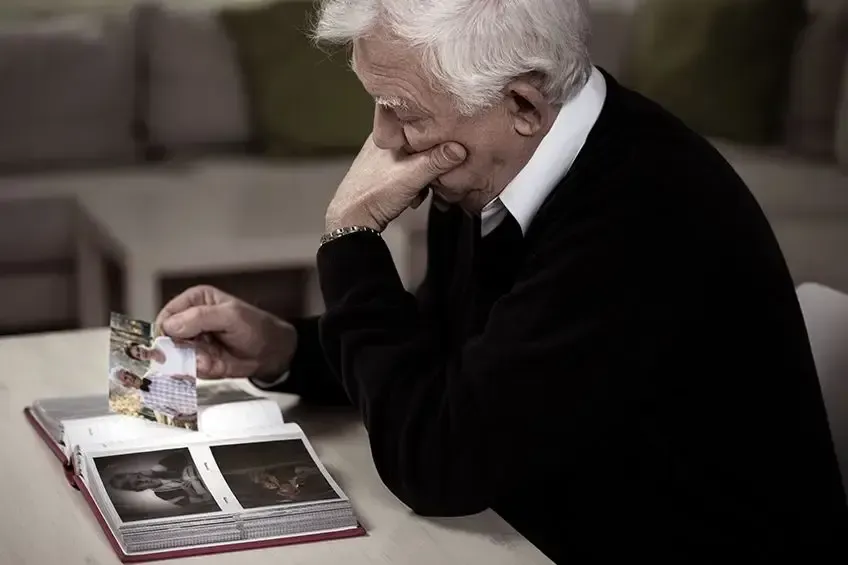
While women and men both feel grief over the loss of a spouse, widowers often have a unique set of needs. This typically stems from the fact that while a woman may have many friends she can lean on following the loss of a spouse, a man may have lost his best friend and closest companion all at once. Perhaps the saying “Women mourn – men replace” has its roots in intense loneliness caused by a lack of previously established close friendships. It has been frequently asked whether a widower would be as driven to hurriedly replace his wife and best friend if he had someone with whom he could share his grief. Men face unique problems as widowers. Many of their everyday needs were probably provided by a wife. Because they are not as likely to be able to take care of themselves as widows, their health and well-being can be severely affected. Widowers may be immersed in feelings they never knew existed and may exhibit painful physical and psychological symptoms. Because women are more frequently the primary caregiver to children, men may face changes in their relationship with their children, resulting in feelings of isolation. Because of their unique needs, widowers, particularly those who lack close friends and family with whom they can talk about their loss and grief, are urged to attend support group meetings or find a counselor with whom they can share their feelings.

There are a number of alternatives to traditional burial in the ground. One common option is to be placed in a mausoleum. A mausoleum is a building specially designed to house the dead; it may be constructed specifically for a single person, or it may be intended to house the remains of multiple people. This isn’t a new concept, and in fact, mausoleums have been in use around the world for thousands of years. Today, many cemeteries offer access to mausoleums, and you might also consider having a mausoleum built as a place for your immediate family to all eventually be entombed together. Bodies in a mausoleum are entombed in a defined space known as the crypt. There are a few benefits to this, and the most obvious is simply that entombment in a crypt is cleaner and dryer than burial in the ground. Because mausoleums are buildings, they provide an enclosed space for visitors to come and pay their respects year-round. And, mausoleums typically use less land space than traditional burial plots do, making them a surprisingly eco-friendly option. Finally, mausoleums offer a defined space that can be reserved for a couple or for an entire family—making it one of the best ways to ensure that you and your loved ones ultimately share the same final resting place and that it’s easy for future generations to come pay their respects. If entombment in a mausoleum is something you’d like to consider, the best way to proceed is simply to reach out to your local funeral director to learn more about the options available to you.

Lent is a sacred period for Christians. It lasts for 40 days, beginning on Ash Wednesday and ending on Easter Sunday. Exactly how this time is used depends on the practices of each individual, but typically it is a time for things such as reflection, prayer, penance, giving, and fasting. Lent is a time to prepare one’s heart and mind for Good Friday and Easter and to remind Christians of the sacrifice made by Jesus Christ. The word Lent comes from the Old English word “lencten” meaning springtime and from the German word “langitinaz” meaning lengthening. Lent is observed in the spring when days are starting to get longer. Lent recognizes the 40 days following Jesus’ baptism when he went into the desert without food or water and was tempted by Satan. By observing Lent, Christians remember Christ’s sacrifice. Easter celebrates the resurrection of Christ following his death on the cross and Lent helps Christians remember the events leading up to his crucifixion. Fasting is a very common practice during Lent. Fasting is seen as a reminder of Jesus’ sacrifice. It can also be used as a time to connect more with God. But not everyone fasts in the same way. While some Christians may fast for the entire period, today most use this as a time to give up a particular vice as a form of sacrifice. Typically these are things like a favorite food or drink. And others may fast only on Ash Wednesday or Good Friday (the Friday before Easter). Another common practice during this time is to give to others such as by donating goods to charity, giving money to those in need, or giving of one’s time to a special cause. Christians do not believe that this time of repentance and sacrifice is done to earn favor with God, as Christians believe that Jesus’ sacrifice on the cross is the only thing that has the power to save. Instead Lent is seen as a time to improve one’s relationship with God, accept his mercy, repent and grow as a believer. Spending time fasting and praying during Lent can make the Easter celebration more meaningful.

If your loved one passed away from coronavirus (COVID-19) you may be eligible for a reimbursement of your funeral, interment or cremation expenses from FEMA. Starting in early April, FEMA will begin providing reimbursement of up to $9,000 for funeral, interment or cremation expenses incurred due to a death from COVID-19. FEMA considers COVID-19 to be a disaster and is therefore providing funds to help ease some of the financial burden on families during this time. Many funeral expenses will be eligible for reimbursement, such as: transfer of remains casket or urn costs related to arranging the funeral service, use of funeral home equipment or staff cremation or interment costs cost of the marker or headstone. These are just some of the costs that may be eligible for reimbursement. Many other costs may be deemed acceptable as well. You can call your funeral home to check what costs may be eligible. If you plan to hold a memorial service in the future or have not yet purchased items such as a monument or any other funeral service/merchandise, you should plan to meet with your funeral home as soon as possible to start the necessary paperwork so that you can take full advantage of your FEMA reimbursement funds. Even if we were not the funeral home you used originally, we are more than happy to help you with obtaining your FEMA reimbursement funds. Fill out this form to download our FREE guide “Navigating Your COVID-19 FEMA Funeral Benefits”, to find out if you qualify for reimbursement. OR Give us a call at 215-637-7373 we are here to help.
While women and men both feel grief over the loss of a spouse, widowers often have a unique set of needs. This typically stems from the fact that while a woman may have many friends she can lean on following the loss of a spouse, a man may have lost his best friend and closest companion all at once. Perhaps the saying “Women mourn – men replace” has its roots in intense loneliness caused by a lack of previously established close friendships. It has been frequently asked whether a widower would be as driven to hurriedly replace his wife and best friend if he had someone with whom he could share his grief. Men face unique problems as widowers. Many of their everyday needs were probably provided by a wife. Because they are not as likely to be able to take care of themselves as widows, their health and well-being can be severely affected. Widowers may be immersed in feelings they never knew existed and may exhibit painful physical and psychological symptoms. Because women are more frequently the primary caregiver to children, men may face changes in their relationship with their children, resulting in feelings of isolation. Because of their unique needs, widowers, particularly those who lack close friends and family with whom they can talk about their loss and grief, are urged to attend support group meetings or find a counselor with whom they can share their feelings.
There are a number of alternatives to traditional burial in the ground. One common option is to be placed in a mausoleum. A mausoleum is a building specially designed to house the dead; it may be constructed specifically for a single person, or it may be intended to house the remains of multiple people. This isn’t a new concept, and in fact, mausoleums have been in use around the world for thousands of years. Today, many cemeteries offer access to mausoleums, and you might also consider having a mausoleum built as a place for your immediate family to all eventually be entombed together. Bodies in a mausoleum are entombed in a defined space known as the crypt. There are a few benefits to this, and the most obvious is simply that entombment in a crypt is cleaner and dryer than burial in the ground. Because mausoleums are buildings, they provide an enclosed space for visitors to come and pay their respects year-round. And, mausoleums typically use less land space than traditional burial plots do, making them a surprisingly eco-friendly option. Finally, mausoleums offer a defined space that can be reserved for a couple or for an entire family—making it one of the best ways to ensure that you and your loved ones ultimately share the same final resting place and that it’s easy for future generations to come pay their respects. If entombment in a mausoleum is something you’d like to consider, the best way to proceed is simply to reach out to your local funeral director to learn more about the options available to you.
Lent is a sacred period for Christians. It lasts for 40 days, beginning on Ash Wednesday and ending on Easter Sunday. Exactly how this time is used depends on the practices of each individual, but typically it is a time for things such as reflection, prayer, penance, giving, and fasting. Lent is a time to prepare one’s heart and mind for Good Friday and Easter and to remind Christians of the sacrifice made by Jesus Christ. The word Lent comes from the Old English word “lencten” meaning springtime and from the German word “langitinaz” meaning lengthening. Lent is observed in the spring when days are starting to get longer. Lent recognizes the 40 days following Jesus’ baptism when he went into the desert without food or water and was tempted by Satan. By observing Lent, Christians remember Christ’s sacrifice. Easter celebrates the resurrection of Christ following his death on the cross and Lent helps Christians remember the events leading up to his crucifixion. Fasting is a very common practice during Lent. Fasting is seen as a reminder of Jesus’ sacrifice. It can also be used as a time to connect more with God. But not everyone fasts in the same way. While some Christians may fast for the entire period, today most use this as a time to give up a particular vice as a form of sacrifice. Typically these are things like a favorite food or drink. And others may fast only on Ash Wednesday or Good Friday (the Friday before Easter). Another common practice during this time is to give to others such as by donating goods to charity, giving money to those in need, or giving of one’s time to a special cause. Christians do not believe that this time of repentance and sacrifice is done to earn favor with God, as Christians believe that Jesus’ sacrifice on the cross is the only thing that has the power to save. Instead Lent is seen as a time to improve one’s relationship with God, accept his mercy, repent and grow as a believer. Spending time fasting and praying during Lent can make the Easter celebration more meaningful.
If your loved one passed away from coronavirus (COVID-19) you may be eligible for a reimbursement of your funeral, interment or cremation expenses from FEMA. Starting in early April, FEMA will begin providing reimbursement of up to $9,000 for funeral, interment or cremation expenses incurred due to a death from COVID-19. FEMA considers COVID-19 to be a disaster and is therefore providing funds to help ease some of the financial burden on families during this time. Many funeral expenses will be eligible for reimbursement, such as: transfer of remains casket or urn costs related to arranging the funeral service, use of funeral home equipment or staff cremation or interment costs cost of the marker or headstone. These are just some of the costs that may be eligible for reimbursement. Many other costs may be deemed acceptable as well. You can call your funeral home to check what costs may be eligible. If you plan to hold a memorial service in the future or have not yet purchased items such as a monument or any other funeral service/merchandise, you should plan to meet with your funeral home as soon as possible to start the necessary paperwork so that you can take full advantage of your FEMA reimbursement funds. Even if we were not the funeral home you used originally, we are more than happy to help you with obtaining your FEMA reimbursement funds. Fill out this form to download our FREE guide “Navigating Your COVID-19 FEMA Funeral Benefits”, to find out if you qualify for reimbursement. OR Give us a call at 215-637-7373 we are here to help.

In our lifetimes we all have those special life changing moments, perhaps some with excitement and overwhelming joy. While some are met with heartbreak and tears. We all anticipate a baby’s first step, first words and first day of school. We anticipate graduation from High School and College. We plan on the bigger things like buying your first car, the joy of a wedding and the pride of buying a new home. What about the other “firsts” that most people don’t necessarily like to think about? There are also many firsts after losing a loved one. It’s those “firsts” that can seem like a mountain that you will never reach the top of. The first night of sleeping in your home alone, the first month of paying the bills on your own and especially the first anniversary of your loved one’s passing. It is difficult sometimes to realize that some things will ever be the same after you lose a loved one. You may feel left out of your circle of friends because they may feel it will upset you to be around other couples. Unfortunately, they do not realize that their actions may actually be making you feel worse. First, know that you are not alone; in fact, there are more people dealing with those “firsts” than you know. Take a deep breath when you are having a “first” moment. Take a look outside and see the beauty of nature. It can be as simple as seeing a hummingbird or a dragonfly or a cloud formation. If you are so inclined: pray or meditate, turn over your grief and stress and sadness to a higher power. Know that you are not alone in these feelings. There are so many others that are going through the same “firsts” with you. We are not just a funeral home, we are your extended family during your time of grief. Our website and office have several grief resources available to you and your family should you need them. If you need to talk about your experience, we are a phone call away. Our staff is always here for you.

After a loved one dies, you are likely to feel a complex surge of emotion. And in that time of grief, you may hear two words that sound similar but have different meanings. The words “grief” and “mourning” are often used interchangeably even though they have different definitions. Knowing the difference between grief and mourning can be very important to the healing process following the loss of a loved one. The term “ grief ” refers to the internal thoughts and emotions tied to the loss of a loved one. Grieving can include many feelings such as disappointment, anger, guilt, sadness, or loneliness. Since everyone experiences grief differently, there is no right or wrong way to feel. “ Mourning ” on the other hand is the outward expression of grief. Mourning includes things like funeral services, visitations, and wakes, graveside visits and services, and other memorialization efforts. Mourning can also include things like crying, journaling, singing songs, or telling stories about your loved one. Grief is feeling sad or upset at the mention of a lost loved one’s name while mourning is holding a graveside visitation on the anniversary of a lost loved one. Separating the two concepts can help make the grieving process a little easier. Mourning helps us contextualize grief. Mourning also gives you a way to work through the feelings associated with grief. A funeral or memorial service gives you an outlet to help you cope with grief. Grief may help you understand why you are emotional during a memorial service. Grief helps us move through loss. Understanding the differences between grief and mourning can provide the tools needed to help work through your grief. When we have lost a loved one, most of us would prefer to ignore the feelings of grief. But research shows that doing so will only delay the healing process. For many, mourning is enough to help them start to process those feelings and emotions and begin the healing process. However, for some, after something as painful and traumatic as losing a loved one occurs, more care is required. Our website and funeral home have resources available to help those who are coping with the loss of a loved one. We are here for you … lean on us in your time of grief.

The grief journey is a difficult one. But the good news is that you can use this experience to grow. Here are six ways to grow on your grief journey. Recognize Your Own Strengths This is likely not your first crisis or loss. Look back on other challenges you have faced and think about what strategies helped you then. Maybe it was having someone to talk to. Maybe it was your own resourcefulness. Your spirituality can also help you address your loss. It may be helpful to talk to those who share similar beliefs. Focus on the Positive Bond Even though your loved one is gone, it doesn’t mean they must be forgotten or replaced. They will never truly leave you. Instead, focus on your loved one’s legacy and the good memories you have. One way you can help keep their memory alive is by creating something like a photo album or memory box. Change Negative Thought Patterns It can be tempting to focus on negative things such as the tragedy of the loss of your loved one. However, it is possible to reframe the language surrounding your loss. Recognize when your negative thoughts are starting to take over and change your language. Focus on positive language such as the courage you are showing while you meet the challenges of loss. Check in With Yourself Take a purposeful look at your journey from time to time. Think about how you have changed. Ask yourself what new skills you have gained or what new insights you have developed. You might even want to keep a journal of your experience so you can see your progress. Use Your Support Systems The grief journey is a difficult one and you shouldn’t have to go on it alone. If friends or family offer support, take it. And don’t hesitate to reach out and ask for help. Sometimes people want to help, they just don’t know how. If you don’t have friends or family to support you, consider joining a grief support group. Stay Hopeful Know that your grief journey will have ups and downs. And your life will be forever changed. But you can still find joy and happiness again. Think about your future and where you would like to be, and then make small changes to help you reach your goal.

When a loved one passes away, the relationship you had with that person affects your grief. Relationships are not perfect, and even good relationships have their ups and downs. Grief can be made even more difficult if you had a strained relationship with your loved one. For example, the last few years of a marriage may have been more challenging due to the added responsibilities of caregiving. Parents and children may have had a conflicted relationship. Even though you loved someone, it certainly doesn’t mean that you were always happy with them. A strained relationship can lead to more challenges in processing your grief. You may feel like you have unfinished business, things you wish you had said (or not said), or things you wish you had done differently. Grief can also bring up old memories that in turn can be difficult to manage. Another issue is that friends and family may not know how to support you if they were aware of your strained relationship. They may not even understand why you are grieving the loss. Or it’s possible that other people might not be aware of your strained relationship and in that case may not understand your conflicted emotions and difficulty grieving. If you find yourself struggling with conflicting emotions, there are some strategies you can employ. You can write a letter to your loved one, expressing your thoughts and feelings that you didn’t get to say when they were alive. You can also try creating a memory box with mementos associated with positive memories. Or spend time with other loved ones telling stories about happier times. If your memories are particularly painful and difficult to bear, consider grief support or counseling. It can be helpful to process your feelings with someone on the outside. No matter what, know that you do not need to go on your journey alone. Help is always available.

Supporting grieving family members is a difficult task and social distancing has made that task even harder. However, this does not mean that grief and loss are taking a break. On the contrary, the fact that we are more isolated now means that it is more important than ever to reach out to and support those who are grieving. Fortunately, there are still plenty of ways to show your support. 1) Help with funeral arrangements. Planning a funeral is a difficult task. If you can’t be there in person, you can still support your loved one in these decisions. If the decisions are made via phone call, offer to be on the call with them. Also, reassure your loved one that even though having a funeral service may feel difficult, it is still possible and even beneficial at this time. 2) Phone calls. Never underestimate the value of a listening ear. Don’t forget to call and check in frequently. 3) Video chats. If you have the capability, video chatting can be a great tool. 4) Have a meal delivered. If you can’t prepare food to take to your loved one during this time, you can contact a local restaurant to provide a food delivery. 5) Have groceries delivered. If you know their grocery preferences, place an order for them for delivery. Include easy to prepare meals in the delivery. 6) Schedule to have someone take care of routine tasks. There may still be services available that are doing routine tasks such as dog walking or laundry care. 7) Send a letter, email or ecard. Sending a heartfelt message is a great way to show your love and support. 8) Send flowers. Many flower delivery services are still operating and can safely deliver flowers to a loved one’s home. 9) Drop off a care package or have something delivered. You might be able to drop off some special items that your loved one appreciates or have them delivered. 10) Do something together “virtually.” So many places are providing free online content right now. Take a virtual museum trip together. Pick out a movie to watch together. Try out a new recipe together. Use a program like Facetime, Zoom or GoToMeeting to share your experience live on your computer, tablet or smart phone.

The body content of your post goes here. To edit this text, click on it and delete this default text and start typing your own or paste your own from a different source.

